Green politics, philosophy, history, paganism and a lot of self righteous grandstanding.

Friday, 26 December 2025

Review of the Year 2025

January

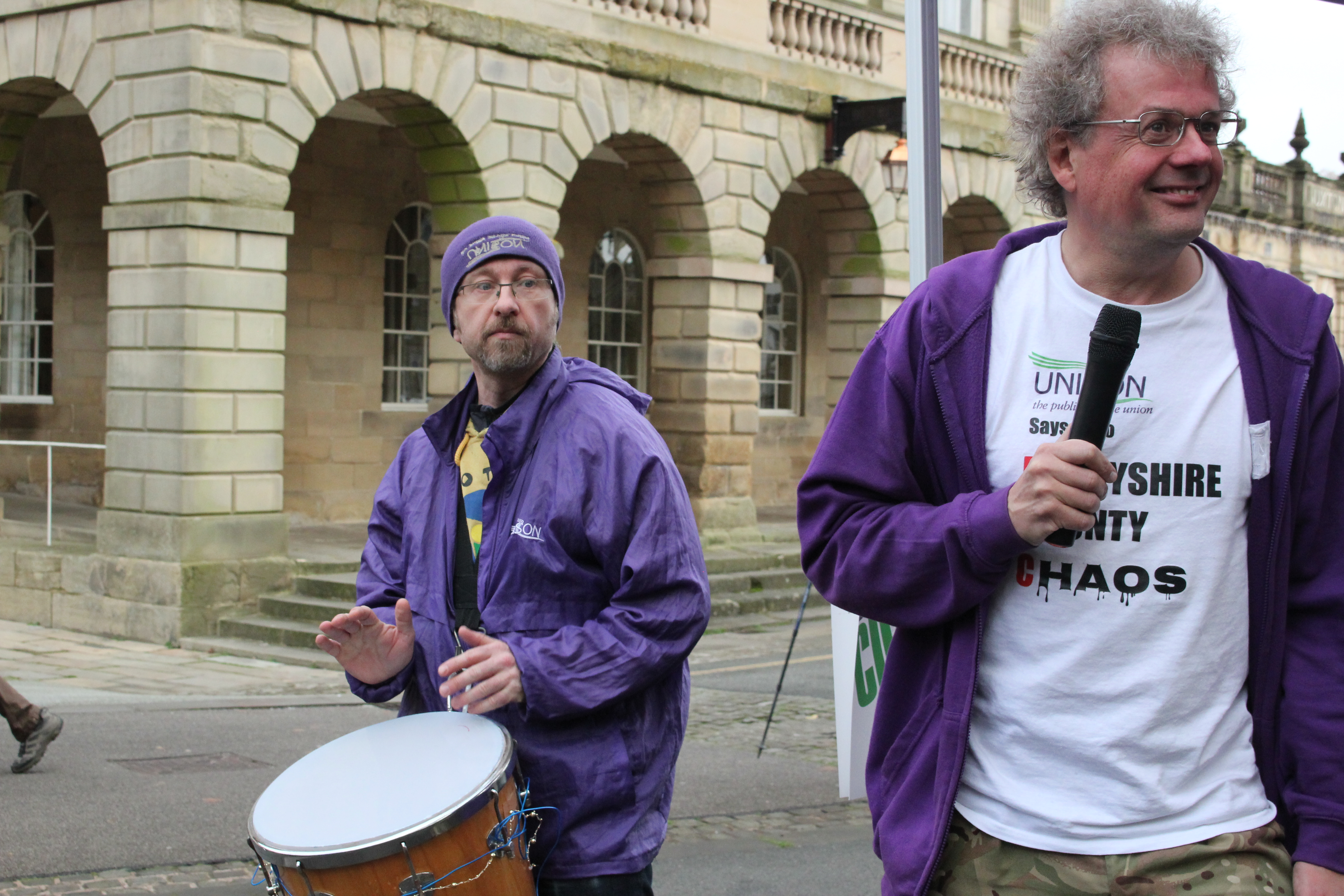
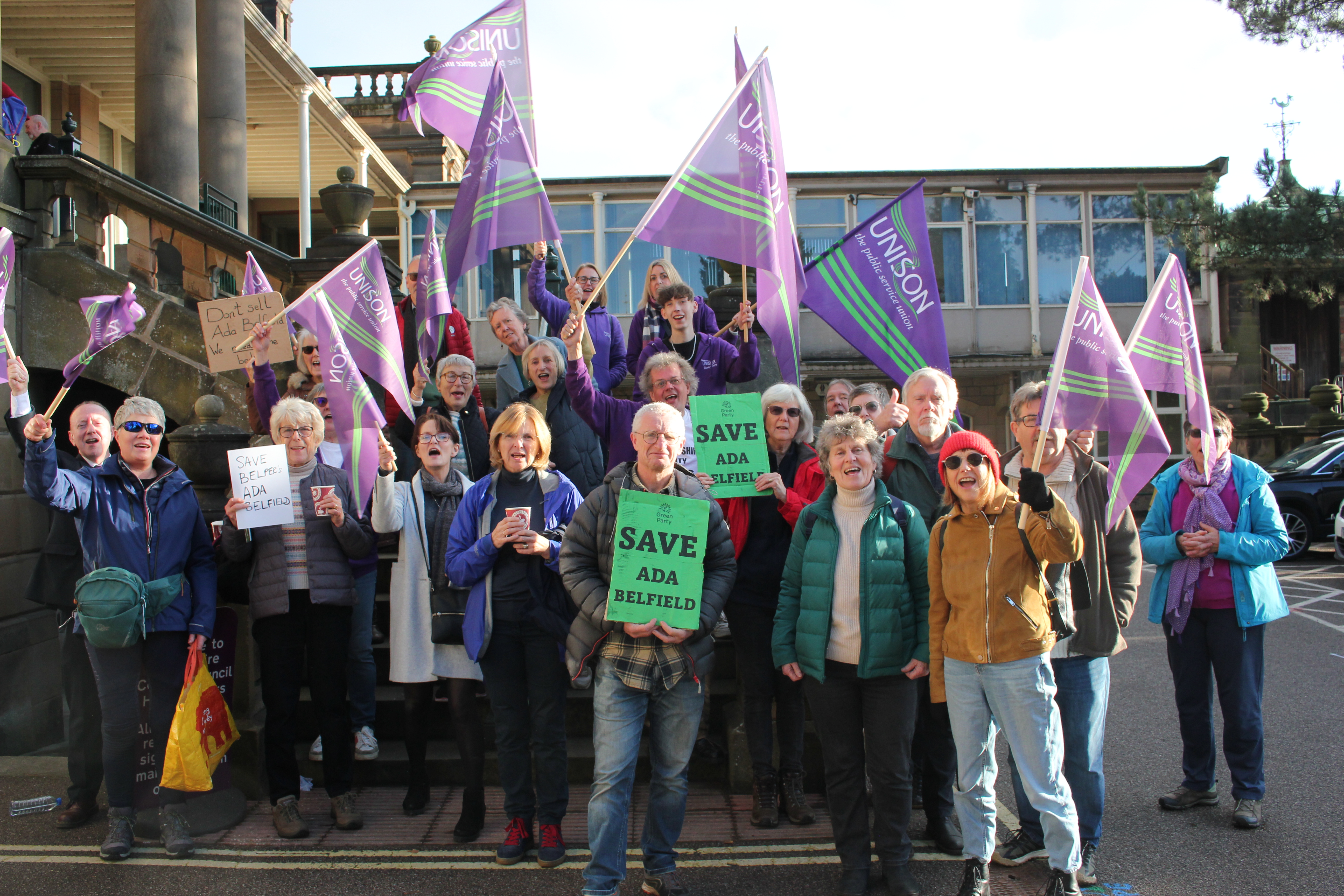
The start of my first year of being a Unison branch secretary, and I'm at a protest against the privatisation of a much loved care home. In 2024 we'd forced Derbyshire County Council to change it's plans to close ten Day Centres and privatise eight Care Homes, but the sting in the tail were plans to sell of Ada Belfield home in Belper.
 
Belper Together had run a good campaign to reverse the decision and organised a Save Ada Belfield rally that attracted press and TV coverage. I took a few photos, including the one on the left, which ended up as the main press photo of the campaign for the rest of the year.

February


I'm down in London for the first direct action of the year. Greenpeace chose a cold but clear morning for their Breaking Point action at Shell headquarters. It was a jointly planned action with Greenpeace Philippines, and we prepared with a delicious vegan Filipino meal in Canonbury Villa, where a delegation from the country told us how their food culture was influenced by both the Spanish colonial occupation and the US military bases.

The next morning we surrounded Shell headquarters and blocked the doors with water filled glass display cases holding domestic items damaged in storms. Then we smashed the glass. My team was round the back. We didn't get in any photos, but we properly blocked the doors. The police don't make any arrests. 

A couple of weeks later I'm in Leicester for the Unison Branch of the Year awards. It's great to be back in the city I took my degree in, and the event is a lot of booze filled fun. Even better, the branch wins an award! We get Campaign of the Year for saving five Day Centres for older people last year. It's great that I was able to use my Greenpeace skills to do it, and even better that Unison recognised this. My team are over the moon. 

I get to explore a bit of the city before I head home, and a veggie curry house that does the world's most amazing aubergines. 

March

Having celebrated ten years since exploration for shale gas ended on Barton Moss, it was the turn of Frack Free Lancashire to celebrate this year.

We had a reunion at the gates of the Cuadrilla Preston New Road site outside of Blackpool, where it really is all over. Cuadrilla need to be gone by the end of the year. 

It was great to meet the old gang again and celebrate a real vistory over the fossil fuel industry. A minor win in the grand scheme of things, but a win never-the-less. For some people it was the making of them, and for others the best thing they'd done in their lives. A victory worth celebrating.

April

I'm back in London again for another Greenpeace action. The Global Oceans Treaty is one of the most important environental treaties ever negotiated. Despited having helped draft it, the UK had still not ratified it. 

To jolly them along, Greenpeace had a message for Foreign Secretary David Lammy. The plan was to hang a banner saying "Lammy Don't Dally" on the arch linking the Foreign Office to the Treasury. It was one of the most heavily policed parts of the UK, so the plan was particularly cunning. 

My minor role was to drive the climb team to their jump off point and then retire to a safe distance, so I missed the real fun. In the end it all went like clockwork. The cover story was so effective the Actions Coordinator had to confess to security that they weren't really doing a survey of the stonework. The action was noted by the government. 

I also managed a free gig at the Manchester Arena, courtesy of Jacob Collier. Greenpeace had him perform on an iceberg, and in return he let local groups have stalls at his concerts. We managed to get a few people signed up to our global oceans campaign, but the man and his audience seemed strangely mismatched. 

May

I'm not particularly religious but I do have my gods, and one of them had a statue unveiled in Burslem in May. Lemmy may have moved out when he was ten, and never showed any sign of wanting to return, but most of Stoke appeared to have turned out to watch the unveiling. 

It's a great statue, and the lyrics to his original Hawkwind song Motorhead serve as an inscription. Some of his ashes arrived with a motorcycle escort to be interred in the base, and Motörhead guitarist Phil Taylor was there, as was one of the Rocking Vicars, Lemmy's first band. I also bumped into Lemmy's first girlfriend, who's a local green campaigner. 

Anyway, back to the activism, and the government still hadn't committed to signing the Global Oceans Treaty, so the Manchester Greenpeace Group took up the cause. Manchester Central MP Lucy Powell was Leader of the House of Commons, and so responsible for allocating Commons time for bills to be debated, so we went after and 'Lammy Don't Dally' became 'Lucy No Excusy'.  

First of all, the Secret Squirrel team went around in the dead of night putting up fly posters around the
city centre, some of which are still there. 

Then, after a few weeks, we started running street stalls in Lucy's constituency, which is now mostly trendy bars and cafes around marinas and canal basins. Her constituents seemed to be clued up people and they were soon sending her emails asking when the government will ratify the treaty. 

The pressure worked, and it was from one of the people who sent an email that we found out the government had committed to ratifying the treaty 'by the end of the year'. They didn't manage that, but the bill to do so is most of the way through parliament, and the UK will join the treaty early next year. Sometimes we win!

May was also the month in which I join up with Extinction Rebellion for the annual protest at the British Insurers Brokers Association meeting in Manchester. Working with XR is always fun, and they pushed the boat out this year - literally - with a life sized 'sinking Lamborghini' that belched smoke and played music. Sadly, there are no heroes in the insurance industry, and everyone is involved in fossil fuels in one way or another. 

My job was again to coordinate the press, with some success. A few insurance companies have now made a commitment to not cover new fossil fuel projects including Chubb, a company we'd been targeting for a year or more. 

June

Greenpeace took us all its local group activists out to rural Staffordshire for a team building weekend. It was a lovely weekend of talks, workshops, excellent vegan food and Scottish country dancing in the magnificent Ingestre Hall, which is over by the local council and cheap to rent if you clean up after yourselves. 

Our 'Lucy No Excusy' campaign was hailed as a success, and we learnt about the plans for the next year.

June was certainly conference season, and I was in Liverpool for the Unison local government conference. We debated how to deal with the rise of Reform UK and I ended up being the last speaker of the conference, although I only got 30 seconds as we needed to proceed to the vote. 

I was able to stay with my parents and visit some of my old haunts in Southport. 

June was also the month of Glastonbury. Once again, I had a free ticket courtesy of Greenpeace. Whilst hanging around backstage I found myself speak to one Mr Billy Bragg. We discussed a George Orwell book we both liked, and he name dropped that he obtained his copy from 'Weller'. Other celebrities I almost bumped in to were Benedict Cumberbatch, Andrew Scott, Simon Pegg, Bella Ramsey and Idris Elba. 

Festival highlights included the Kaiser Chiefs, Peter Capaldi guesting with Franz Ferdinand, Terrorvision, seeing an amazing set by The Prodigy, being a roadie for Elvana, having a distant view of Kneecap (whilst working) and being in the mosh pit for Lambrini Girls, which led to a minor injury. 

July

The heat wave continued throughout July, except for the weekend of Chesterfield Pride, where our Unison stall was flooded. The good weather was great for camping, but it was not good for our reservoirs, some of which now had sheep grazing in them. To show people what a climate crisis looks like, Stuart took his drone to the Woodhead Reservoir and we did some filming for the Greenpeace group. 


This year it was forty years since the French government bombed the Greenpeace ship Rainbow Warrior in Auckland harbour. The tragedy was remembered in a variety of ways, including an excellent series called Murder in the Pacific by the BBC, which is essential watching. In Manchester we showed a different film, Edward McGurn's 2023 documentary Rainbow Warrior, at an event for Greenpeace donors. It was a reminder of why we do this. 

August

In August I was a guest of the Lewes Greenpeace Group, as they were celebrating the time when their small town had been home to the global headquarters of Greenpeace. They had an exhibition, mostly consisting of the memorabilia of John Pay, the former head of Greenpeace International books.

How Greenpeace ended up in Lewes is a strange story, but only one of several strange stories in the history of Greenpeace, my version of which I was able to tell as part of the week's celebration. You can watch it here.  

I also discovered Lewes is a very small town. 

Meanwhile, it has been a year of Far Right thugs shouting at hotels, and in August they arrived in
Manchester. On some protests we outnumbered them, and in others they outnumbered us and it got a little hairy. 

It wasn't on the scale of last summer's riots, but whereas in 2024 the tabloid press was mostly on our side, this year it was very clearly stoking the flames. The actual asylum seekers very sensibly stayed away, but the volunteers we met who worked with them said they were the 'loveliest people you could meet', which is nobody said about the fascists. It was a dangerous business, although I avoided serious injury. 

September

As I now have adult children (allegedly) my wife and I were finally able to have a holiday outside of peak season. We went off to Orkney and spent the best part of a week looking at historical sites from the Neolithic to the Second World War. 

It was a wonderful week looking at stone circles, climbing inside passage tombs, trying to decipher Viking graffiti, looking at bits of First World War battleships and drinking beer and whiskey. The weather was mostly pleasant, and the one stormy day caused our ferry back to Scotland to be cancelled thus extending our holiday. 

Holiday over, I was back in Liverpool again, this time with Greenpeace. The Labour party conference was on and Greenpeace had a new campaign telling people that it was fossil fuels, not renewables, that was pushing up their electricity prices. We launched a postering campaign to start things off. Policing of the conference area was pretty tight, but we managed to get a few up before we caught the attention of the Merseyside plod.

Other teams put up signs in bus shelters and we made our mark. A lot of Scousers showed their support and we were noticed in the conference. 

October

We continues the Great Gas Rip Off campaign with street stalls. 

Sadly, in October we said goodbye to the Manchester Greenpeace Group's veteran member Ian Brown. A very private man, his family were able to reconstruct his life for his funeral. As well as supporting Greenpeace, and the anti-fracking campaign, he was a huge jazz fan and many Manchester bands had their performances recorded and archived by him. He also edited the Manchester Wildlife Trust's magazine, and his archive of old copies is now in Manchester Central Library. He will be missed. 

November

I became Branch Secretary of Unison Derbyshire at the end of 2024, and spent most of the year rebuilding the branch. This didn't leave much time for campaigning, but towards the end of 2025 a campaign more or less fell into out lap. The Derbyshire County Council teams that assess Children with Special Educational Needs and Disabilities (SEND) had been failing for some time due to understaffing. A disastrous OFSTED report did little to help the situation, nor did our attempt to organise the staff, who were leaving the department as fast as we could enlist them. The only comment from new Reform UK council leader Alan Graves was that the problem was one of 'overdiagnosis'. 

However, towards the end of the year two things happened. Firstly, DCC appointed a no-nonsense external head of SEND who told them that they had no alternative but to significantly increase staffing. Then a group called SEND Sanctuary UK organised a national series of protests involving leaving empty shoes outside town halls. 

In Derbyshire, this brought a lot of parents of SEND children together. Unison Derbyshire joined them for the protest, then teamed up with sympathetic councillors to form a pressure group to get the council to provide the resources the SEND teams needed. 

Meanwhile, it was that time of the year again when world leaders try to solve the climate crisis. The USA didn't even bother this time, but some of the others did. 

As usual, Extinction Rebellion organised a rally in Manchester to encourage them, and my union provided the PA. This one proved a little different from previous XR events, as the Far Right turned up. The police did little whilst fascists thugs intimidated families with children except stop us dealing with the problem. We managed to complete the rally with no serious problems, but two women wearing kaffiyehs were later assaulted as they left the rally. As far as I'm aware the police have made no arrests despite the incident being filmed by the perpetrators.

December

Our SEND campaign meanwhile was almost immediately successful. We didn't need to organise a second County Hall protest as DCC voted to give SEND almost all the team had asked for. It was a significant, if easy, victory and became the subject of my first self-penned article in the Morning Star. 

We didn't have much time to celebrate though as DCC then announced they were closing eight care homes, leaving fifty residents to find new homes and two hundred staff at risk of losing their jobs. 

I tried to rally as much opposition as possible and Linsey Farnsworth MP asked a question to Keir Starmer at Prime Ministers Question Time. I was able to brief her personally as I was already in Westminster for a different event. She was also able to get me into Portculis House and though the tunnel that leads to Westminster Hall. 

The event that led to me being in London was a mass lobby of parliament by Unison migrant care workers. The care sector relies on migrant workers, but the current visa scheme means that if a carer falls out with their sponsor they only have a sort period of time to find another before they are deported. This gives bad employer the power to exploit their staff. With over 100,000 vacancies in the care sector Unison wants sector wide visas to allow staff to leave abusive bosses.

The press the point Uniosn managed to get about 700 migrant care workers to London. Many were able to get into parliament and speak to their MP personally, including some of my members. It was a great day that hopefully will do some good. Sadly, the current government seems to be prepared to risk the collapse of the care industry, and the NHS, to appease the Far Right. 

So, a lot of activity, some success, but a lot still to do. Oh well. Roll on 2026. 

Monday, 17 March 2025

Saint Patrick's Chapel, Heysham

What links the patron saint of Ireland to the pioneers of heavy metal?

The answer is the village of Heysham in Lancashire, and specifically St Patrick's Chapel, which stands on a headland by St Peter's Church. Heysham village is a small, and rather scenic, part of Heysham town. Looking around, it seems that you don't have to be an artist to live there, but it certainly helps. Next door to the south is a nuclear power station and ferry to the Isle of Man, and to the north are the endless sands of Morecambe Bay. Across the sea the mountains of the Lake District are usually looming out of the clouds. 

The church itself is older than the Doomsday Book. There's the remains of a high cross, a stone depicting Lazarus, or maybe Jesus, rising from the grave and, best of all, a wonderful Viking Hogback Stone. This is a grave marker decorated with stories from Norse mythology, and was outside before being brought in for safety. These are a North of England thing, although there is one in Ireland, and they may be the Vikings learning to do art like the Anglo-Saxons. Unfortunately, the church is usually locked so most people only get to see it through the window.

The chapel is round the back, perched on the crumbling headland. It supposedly marks the place where Patrick returned from Ireland after spending six years a slave there. Paddy had supposedly been kidnapped by pirates from his home, although some scholars have speculated he was simply dodging some rather onerous public service on the town council.  

There's no other evidence that this was where Paddy landed. In his own account he landed in a 'wilderness' and had to walk 28 days to civilisation, growing faint from hunger, which doesn't say much for the welcome he received. However, he must have come ashore somewhere, and nowhere else has a serious claim. 

The chapel itself is in ruins now, but there is enough left to see what it would have been like. It's interesting enough and an important part of the history of Christianity in England. They found a pagan burial in its grounds when the archaeologists last had a poke around, but what's really interesting is the unique rock cuts graves nearby; six to the west and two to the east. If they look familiar, in the year 2000 Sanctuary Records released an 'unofficial' Best of Black Sabbath and put a moody black and white picture of the western graves on the sleeve. 

They are orientated east to west, which suggests they are Christian. When in use they probably had stone lids, and the sockets by their head may have held crosses. Although roughly person shaped, they are too small to hold a whole adult and the suggestion is that they held the preserved bones of particularly venerated individuals or saints.  

So, who would be the most venerated saint that they could have got their hands on? Well, the answer is obvious, Saint Patrick himself. The Irish will tell you he died in Downpatrick, on 17 March 461CE. However, they admit he had been living in England for a number of years before then and claim he took ship across the sea because he wanted to peg out in the Emerald Isle, which is possible. However, it's rather more believable that he died at home in England, and the idea that his bones eventually made their way to the spot where the sacred spot where he had first returned to England.

Sadly, all the archaeology places the chapel well after the time of Patrick, but there must be the slim chance that something else was here before this chapel and maybe there is some truth in the story. 


Saturday, 14 December 2024

Review of the Year 2024

January

The New Year starts with a new role, as Adult Care Convenor for Derbyshire UNISON. For good measure I also take on the social media role and get the interactions up from four a day to several thousand a month.

The quiet start to the year does give me a chance to enjoy the Derbyshire countryside in winter. Mostly it is wet and overcast, but some days are clear and cold. 

Greenpeace though has plans for me and I'm down in London at the weekend taking acting lessons ready for the first action of the year, appropriately named Mulled Wine. I have to get into character as the city wide boy who has just made a pile out and doesn't care about the planet. 

February

Bright and early on the first morning of the month Mulled Wine takes place. We arrive outside Shell's HQ, behind the London Eye, wiht our burning sign and act out our roles of rich psychopaths celebrating making a packet out of burning the planet. On the third take I get a shower of (alcohol free) champagne. It all goes well and the pictures are soon out on the wires. The Daily Mail uses one in a straight article about Shell that doesn't mention Greenpeace. 

I'm cleaned up and debriefed in time to get to Westminster Magistrates Court where my friend Jeff is up before the beak along with Greta Thunberg. Phil of the Arctic is there too. I couldn't stay for the verdict, but they all get off in one of the first tests of the new Tory anti-protest legislation. 


March

We've been campaigning against the insurance industry in Manchester for a while, and this year Extinction Rebellion came on board and we organised a big demo against four international companies who are insuring fossil fuel projects. 

Fresh from my performance at Shell I am enlisted as the corporate stuffed suit with a conscience who has some doubts about where the money is going. The weather is mostly kind to us and XR can certainly put on a good show. It was great political theatre.

Greenpeace also made use of me in March. They assembled a mock graveyard outside parliament to highlight the people who die each year due to fuel poverty. As usual with Greenpeace operations it was meticulously planned, and starts very early in the morning. However, they failed to account for a hire van breaking down. I was only there to carry the props, but we ended up having to improvise rather more than was planned. 

We still managed to get the display in place before the parliamentarians dropped by. I ended up photo bombing Natalie Bennett. I meet the one and only Steve Howe, and he photobombs GB News who are filming something completely different. 

The downside of the police not being bothered by us is that we have to clear everything away ourselves. However, we are a dedicated team and manage to squeeze two vans loads of tat into one to get it all back to the warehouse. 

April

In April 2024 it is ten years since the Barton Moss anti-fracking campaign came to an end. It was a minor episode in the campaign that drove the frackers out of the UK. The campaign began in West Sussex and ended in Lancashire, but we did our bit. The cmpaigners who won at Preston New Road did their first actions at Barton Moss, and the councillors who voted against fracking did so after seeing us on TV. Greater Manchester mayor first learnt about shale gas from us, and he then went on to a make Manchester a green city.

With IGas gone the Moss has been returned to the birds, so a few of the veterans go for a nature walk around it. Obsever Ethical Award Winner Anne Power is able to join us, which was great, but where did the last ten years go?

Greenpeace has an away day for their activists in April, as we've haven't really had a big get together since COVID. It was a fairly laid back affair. We were up in the Lake District near Grassmere in wonderful countryside. I climb Loughrigg fell and went for an early morning swim in the tarn.

My fire lighting skills are called into action and I light the fire we sit round in the evening. There's a worry we might have locked ourselves out of the Youth Hostel, but if that had happened we probably had the skills to get back in again. 

Mozza talked about his time in Reclaim the Streets, and I chip in with my stories from that time. It's great, but in the feedback when we're leaving someone says they enjoyed 'hearing stories from the elders'. I guess I am one of them now. 

May

It's back to campaigning against insurance companies with XR in May. The industry is having its big gathering in Manchester again, and this time we put on a proper show. 

There is a packed program of events running all day. We get the delegates as they go into GMex, and a number come out again later to watch us. I'm back in character as the nice stuffed suit again, but we're all somewhat overpowered by the Red Rebels. 

I'm also on press liaison duties, so I run around doing interviews once I've stopped performing. The insurance industry press appears to have noticed us and we get some decent coverage. 

June

June ended up being a busy month. First, UNISON sent me to Brighton for their annual conference. The event showcased the best and worst of UNISON. We're a passionate, diverse group of people dedicated to campaigning for workers rights, but we spending a lot of time arguing about points of order. 

There's some serious business to attend to though, as there's a motion to affiliate with the Ukraine Solidarity Campaign. This is a solid left-wing group backed by John McDonnell and some big trade unions, but the tankies mobilise in force against the motion. I take my place in the line ready to speak, but the vote is called before I do. We win, and it isn't even close really. 

I also got to walk in the Downs and visit Eastbourne Greenpeace, and on the way back home I passed through London at the same time as the March for Nature. It was very spectacular, and completely ignored by the press. It was a lot of fun, but not as much fun as where I went the week after: the Glastonbury Festival.

Greenpeace again had me as a team leader, and I have a great bunch of people working for me. There was no major band I was hoping to see, but that was fine. Instead, I discovered new bands. Lambrini Girls were the find of the festival. Idles were excellent and Skindred were something. I also discovered Coldplay aren't boring live. 

Best of all I was stewarding on the Greenpeace field when we had a celebrity guest. It turned out to be Simon Pegg and I literally lost the power of speech. All I could manage was a Vulcan speech sign, which he returned. I'm not worthy! We also had Jane Goodall drop by the stage, but she's never been into space. 

July

And then there was a General Election and we finally got rid of the Tories. Although probably the biggest victory for the environment in the UK this year, I didn't really have anything to do with it, the Labour Party having banned me as a dangerous radical. I enjoy the night though and stay up for to see Rees-Mogg lose his seat.

The rest of the month is mostly spent on holiday, including the Leicester Astrophysics class of 1988 who rented a tipi and a yurt in Lincolnshire for a weekend of drinking, talking bollocks and culture. 

Fen End Farm is an organic farm that I can't recommend enough and we all had a great time.

Then, at the end of the month, there are some horrific murders in the town of Southport where I grew up, followed by a riot.

August

And then just like that the Far Right was back.

August was an unusual month. The Far Right revival seemingly came out of nowhere, although actually it came out of social media, especially Twitter/X.

In response, the anti-fascists took to the streets. They were an interesting bunch. The usual suspects of Stand Up To Racism and the various Manchester green groups were there, as were lots of perfectly ordinary people. What was missing was pretty much every political party except the Greens. I was able to attend officially as UNISON, and some other unions were there too, but almost no other organised groups. Even UNISON wasn't all there, as when I tried to organise a rally in Buxton pressure was applied from above and it was cancelled. 

We outnumbered the fascists on every occasion and only at the first protest in Manchester were the Far
Right present in enough numbers to give them confidence to have a go at us. Greater Manchester Police were onto it before anyone did me any harm, but several hours after we'd left drunken fascists trashed a supermarket in Piccadilly Gardens. In some ways I was lucky. Colleagues went to a counter demonstration in Rotherham and encountered hate like they'd never seen before. 

Thanks to Stand Up To Racism organising the counter-protests, and the courts throwing the book at the rioters, it all died down. However, the at which the Far Right organised via social media, the failure of most parts of civil society to take a stand, and the complete lack of a subsequent debate about how so many people with no history of Far Right involvement had been weaponised by the tabloid media suggests serious problems for the future. 

September

Greenpeace had another job for me this month. The campaign against single use plastic has been going on for a while, and I'd done some covert research last year by planting bugging devices in recycling bins which became a serious piece of research

The worst problem are in the Global South, where many products are produced in disposable sachets that clog up water sources and eventually oceans. The global corporation Unilever produces more than anybody else, and also plans to lead the industry delegation at the negotiations for a Global Plastic Treaty later in the year. They also produce Dove, a product with a very well-crafted public image.

They were therefore the obvious target for Greenpeace UK's biggest action of the year. In the early hours of the morning I was at the wheel of an (electric) van that was part of an eight-vehicle convoy that hit their offices before dawn. In a well drilled manoeuvre, lock-on barrels were deployed at each of the buildings dozen or so entrances, whilst two ladder teams - one led by me - helped the climbers onto a ledge form where they could deploy their 30kg banner. 

It all went like clockwork, which meant I was back in Islington for an organic vegan breakfast. The lock-on teams meanwhile endured twelve hours outside in the cold, and then 24 hours in police custody. I did my best to support them by ferrying them supplies in Greenpeace's other electric vehicles, but it wasn't an even division of labour. It was an effective action though, and Unilever were very keen to negotiate with Greenpeace afterwards.  

October

Meanwhile I continued with the day job. Derbyshire County Council, which only a couple of years ago was boasting about how low its council tax was, had got itself into a bit of financial difficulty. They drafted in an ex-Brigadier for advice and responded with a swath of cuts. Having virtually wiped out its own Sure Start Centres it moved on to Adult Care, with plans to close or sell day centres and care homes. 

Finally, I get to use my campaigning experience at work. We organised public meetings, sat down with the management, met with MPs, put out press releases and I showed the branch how to use social media. With the decision to be made in November we had a final push in October with a series of rallies across the county. People turned up and we attracted press attention. Soon we would find out if it had worked. 

November

So, on 6 November the cabinet papers were printed. And we'd won. Sort of. The council had completely redrafted its plans for older persons care and three day centres and three care homes that had been at risk were saved. It had been a lot of hard work, and two members of our organising committee had lost their own jobs in the process, but we'd won something, which Derbyshire UNISON hadn't done for a while. It turns out I do have some transferable skills after all. 

The same day I am elected Branch Secretary of Derbyshire UNISON. 

We organised a demostration at County Hall for the actual decision, and I get my mug on TV again.


December 

And so the year drew to a close. The UK was hit by storms Bert and Daragh, but I managed to make my way to London for a UNISON Social Work seminar regardless. 

There was one last gig for Greenpeace, and it was at a gig. Jacob Collier allowed Greenpeace to ship him to Svalbard to play his piano, and in return we could have stalls at his concerts. People signed postcards to stop Deep Sea Mining, then I saw him play. Not really my taste.

The next day was The Greater Manchester Green Summit. I've been to all of them and it was great to see Andy Burnham's vision progressing.

So, that was 2024. A year of extreme weather and extreme politics. We didn't get a Global Plastics Treaty, but there wasn't a deal to allow mining the ocean floor either. We lost the Tories but gained Trump.

Oh well, better keep fighting next year then. 

Monday, 10 June 2024

The Epic of Everest: The Future


So, with the hundredth anniversary of Mallory and Irvine disappearing into the silence on Mount Everest has passed. Hopefully, a few more people in the world now know their story, and the mystery that surrounds their fate. 

We know so much more than we did in the 1990s, when I first became interested in the subject, via a biography of Francis Younghusband. But we still don't have the answer to what happened on 8 June 1924 on the world's highest mountain. So, what more can we hope for from future research? Is it possible we will find out the whole story?

Evidence on Everest

Firstly, what is the prospect of more evidence being collected on Everest itself? 


Mallory and Irvine died in the ’death zone’ of Everest. This isn’t just a turn of phrase, it’s literally true. Even if you have enough oxygen, and nobody ever has enough oxygen, and even if you eat and drink sufficiently, which is also impossible as the altitude destroys your appetite, your body is dying all the time you are at over 8000 metres. With altitude comes bad weather. Everest gives mountaineers just a few days a year when it is safe to climb. The rest of the time the summit is in the jet stream, meaning not just bad weather but bad weather at 100mph. Put those two facts together and any search of the summit will only have a brief window of time.

Then there is the nature of the summit itself. For all that Everest is a ‘non-technical summit’ it is technical enough. You are climbing and if you don’t pay attention to where you put your hands and your feet it's a long way down. Plus, the relative ease of the summit only applies to the main routes, which follow the ridges and are roped and laddered. To search the summit for Irvine you need to come off the ropes and risk your life on the face itself, in the death zone, in the weather.

This brings us to the organisational problems of a search. Every year thousands of people climb Everest, almost all with organised teams. The companies that run these climbs have one goal: to get their clients to the top and bring them home safely again. Clambering around off the ropes is not what they do. Nor is it what the Sherpas want to do. Sherpas earn decent money in a part of the world where that is very hard. They work tremendously hard and take stupendous risks to do this. The more times a Sherpa summits, the more money they can earn in a career that is obviously not going to be that long. To take all the risks of going into the death zone without summitting is asking a lot of them.


These problems can obviously be got round with sufficient time and money, but there is another problem: the Chinese authorities. Everest straddles the Tibet and Nepal, but Mallory and Irvine disappeared on the Tibetan side, so any search party will be on the part of the mountain that the Chinese manage. Now China runs a tighter ship than Nepal in many ways. Certainly, far fewer people die on the Chinese administered side. However, in part this is because the Chinese authorities don't let foreigners wander around wherever they want. 

For all the problems I’ve described Everest is not the Moon. It’s not even the Sahara Desert. It’s a relatively small area of land that has been traversed pretty much every way it can be traversed and which has been surveyed by satellite, aeroplane, drone and every other imaginable way. 

It was one such search party that found the body of Mallory in 1999, on the slope below the First Step, seemingly killed by a fall. Given the conditions, the examination of it was somewhat less thorough than anything Professor Alice Roberts or Time Team would have done at ground level. The body was left on the mountain, so a more forensic examination may still be possible. 


But what about Sandy Irvine? Following accounts by Chinese climbers, Everest expert Tom Holzel went over an eight-foot-long aerial photo of Everest he had in his basement with a magnifying glass, trying to trace the routes the people who claimed to have seen him. He identified a smudge just above where Mallory’s body had been found as the most likely location. In 2019 an expedition was launched and, after many difficulties mountaineer Mark Synnott finally made it to the ‘Holzel spot’, only to find nothing there. Slightly confusingly though, the spot was not a crevice, as thought, but just a dark patch if rock. The various accounts of the 'English dead' spoke of a body in a shallow hollow, which is also where you'd expect to find someone sheltering from the elements, so it's still possible this was not the right area. If he's still there it should be possible to find him with a bit of effort, although, as we'll see later, there is a big 'if' there.

Smaller objects may also remain to be found. Mallory and Irvine appear to have taken, used, and then discarded five oxygen cylinders. Only one has ever been found. Finding another would be of huge importance. Plus, Mallory wasn't wearing the rigging for the kit when he died, so that must be somewhere too. Irvine also had a rig, and if that's not on his body it too would have been discarded on the mountain. At present no physical evidence puts Mallory or Irvine beyond the First Step on the Northeast Ridge, so anything higher would be a significant new find. Objects would also give an indication of route. If something turned up in the Great Couloir it would solve a century old debate about their route and make arguments about the second step redundant. With Mallory's body was found a note on his where he had recorded the serial numbers of the oxygen cylinders he took and their pressure, so if a cylinder was found we would know if it was one of his. As well as showing how far they got and by which route, where an oxygen cylinder was discarded would give an indication of rate of progress. 

Perhaps the most sought after item though is the expedition's Kodak camera. It was not on Mallory's body when it was found and whilst there is a slim chance it was lost in the fall, more likely it was with Irvine. Kodak apparently have some confidence they could get something from hundred year old film. A photo of the summit would settle the whole argument. 


Finally, the object that I would most like to find would be the picture of Mallory's wife, Ruth. Mallory said he would place the picture on the summit, and it wasn't on his body when it was found. Maybe he forgot it - he was like that - or maybe it was lost in the fall, or in the sixty plus years his body was exposed on the mountain. Most likely though he left it at the highest point he reached. Nobody has seen it on the summit and Sir Edmund Hillary, the most likely person to do so, spent some time looking in 1953. If there is one piece of evidence that would convince me Mallory did not stand on the top of the world, it would be a picture of Ruth found tucked away at the Second Step or in the Great Couloir. 

Evidence in China

So, who were htose climbers who spoke of seeing 'English dead' on Everest? In 1960 Xu Jing was second in command of the Chinese expedition that was the first to climb Everest from Tibet and descend safely. He claimed he saw a body whilst up there, although it wasn’t until 2001 that he told his story to anyone in the West. In 1965 another member of the team, Wang Fu-chou, gave a talk in Leningrad in which he recounted seeing a the body of a dead ‘European’ at 8600m. This startling news was recorded in the St Petersburg Alpine Club Journal, but nowhere else, and hence was not noticed by anyone outside of the Communist block for half a century.

The next recorded sighting was by another Chinese expedition in 1975. Wang Hongbao wandered off the established route whilst trying to rejoin his team and came across the body of an old “English” dead. Hongbao told this story to a fellow climber in 1979. The next day Hangboa was killed in an avalanche so, once again, it was mostly ignored. China denied this story for years but then in 1986 the man who Hongbao had shared a tent with in 1975 confirmed it to mountaineer and Everest historian Tom Holzel.

Finally, in 1995 Sherpa Chering Dorja, descending ‘via a more direct route’ also found an old body. By this time though people were taking note, and three years later an expedition was launched to find the body. In the end they found, not Irvine, but George Mallory, but this body was also not in the spot described by Xu King, Wang Hongbao or Sherpa Dorja.


Then, in 2021, came a claim, via a source at the British Embassy in Beijing, that a 1975 Chinese expedition not only found Irvine’s body, but retrieved a camera from it. The body had allegedly been found by Pan Dao, a remarkable woman who was the first to summit from the north side, and the first Tibetan to stand on top of the world. Pan Dao thought that Irvine had died of the cold, rather than a fall. What really made Pan Dao’s story stand out though was the claim that she had found and retrieved a camera from the body.

In 2010 China had launched a big clean-up of Everest, removing over half a century’s worth of rubbish and dead bodies. Rumours were soon swirling round that amongst other things removed from the mountain was at least one “English dead”, although five-times Everest summiteer Jamie McGuiness was told by an official of the China Tibet Mountaineering Association that the body was removed "much earlier than that".

It's also possible Irvine’s body might not have been the only one disposed of. In 2007 Conrad Anker, who’d found Mallory’s remains in 1999, returned to the same spot but couldn’t find him. Neither could a drone flown by a 2019 expedition.


Why would China be doing this? Well, their 1960 ascent, the first to summit Everest from the north, is to China what putting Yuri Gagarin into space is for the Russians or Neil Armstrong on the Moon is for the Americans. After their ‘century of shame’ when Europeans all but colonised the country, after the devastation of the Second World War and the turmoil of the Cultural Revolution, they do not really want to promote the idea that a pair of British amateurs might have got there first.

So, what would it take to get the Chinese to reveal what they know? 'Money' is the usual answer, but on a sensitive subject like Everest even money might not be enough. The answer then to my original question is that we really don't know when there will be an answer to this mystery. 

Saturday, 8 June 2024

The Epic of Everest: The Mystery of 1924


One hundred years ago today, two young men set out on one of the most remarkable adventures in human history. 37 year old George Herbert Leigh-Mallory, the greatest climber of his generation, and 22 year old Andrew Comyn 'Sandy' Irvine, an expert at repairing the new fangled oxygen equipment they were using, left their camp 7000 metres above sea level, and attempted to be the first people to reach the summit of the highest mountain in the world. They were never seen alive again. 

The first person to be asked to climb Everest appears to have been a chap called Francis Younghusband. A Victorian British Army officer he made his name with various acts of daring-do in what came to be called the Great Game, a sort of  Cold War in the Himalayas between the British and Russian empires. The conversation took place in 1893, on the polo ground in Chitral, an obscure place on the northwest frontier that had just been the scene of one of the bloody little wars of empire. Captain Charles Grenville Bruce of the 5th Gurkha Rifles suggested it to Younghusband, although it could have been other way round. Grant, a volcano of a man in both size and temperament, is the person who introduced shorts to the British Army and had once commanded Younghusband's Gurkha escort during one of this Great Game expeditions.

It took nearly 30 years for the plan to come off, by which time both men were too old for the climb themselves. By this time Younghusband was president of the Royal Geographical Society. He was also a mystic who believed in free love, the unity of the world's religions and a cosmic intelligence living on a planet called Altair, but this didn't stop the RGS teaming up with the Alpine Club to launch a reconnaissance expedition to Everest in 1921. The team included Mallory, who spied out the terrain and chose the route he would use the next year to try for the summit. 


Prior to this expedition, British surveyors had only seen the top of Everest. They had no idea what the rest of it looked like, or even if they would be climbing rock or snow. What they saw was impressed them, but did not put them off. "An easy rock peak" was the verdict. Imperial arrogance, for sure, but also the voice of experienced Alpine climbers. Everest stands 10,000 feet above the Tibetan plateau. By contrast, Mont Blanc stands 14,000 feet above Chamonix. What makes Everest a challenge is not its prominence, but its altitude. Climbing at 29,000 feet is not the same as climbing at 15,000 feet.

The party could not do much about the weather, except pray that the monsoon was late, but they could do something about the lack of oxygen. When they returned in 1922, with the team by General Charles Bruce, as he now was, they brought oxygen cylinders with them, much to the chagrin of Younghusband, who thought they should have more faith in the human spirit. These early systems were heavy and unreliable, but they proved their worth.

But the 1922 attempt was ended by tragedy. Mallory and the climb team accidentally caused an avalanche that carried away seven Sherpas following up below. At this time the Europeans didn't appreciate that Sherpas were the key to Everest, instead using them as little more than high altitude pack animals. The compensation the families of the dead received was £13 a Sherpa, which seems insignificant, but is actually, when you allow for inflation, more is paid today. The reaction to this amongst the team was interesting: "Why was it not one of us?" said Mallory. This was the guilt of a survivor of the Great War.


The party returned home, defeated, and it would be two years before they could return. Mallory was now in his late thirties, and negotiations with China for access to Everest were getting difficult. All concerned knew this would be the last chance to reach the top of the world. So, on the morning of 8 June Mallory and Irvine set off for the summit from Camp VI, clinging to the mountain just below it's Northeast Ridge. Did they make it to the top?

At first glance it’s quite implausible. Compared to modern expeditions, Mallory and Irvine camped further down the mountain and started their final ascent after dawn, rather than in the night. Expedition barometer readings taken at Base Camp, when analysed with modern technology, suggest they were also attempting the summit in low pressure, which reduces the oxygen in the air and effectively makes the mountain a few hundred metres higher. They were also  hit by a snow storm for good measure, which in those conditions is often fatal even for climbers in modern clothing. They were going where no man had gone before and were having to invent their own route as they went. The odds were very much against them.

There are clues as to what happened. Noel Odell, who was one camp below them that morning and following them up the mountain, believes he saw two figures climbing the Northeast Ridge just before 1PM, when the swirling mists parted for a moment. A subsequent failed British attempt to climb the mountain found Irvine's ice axe just below the First Step on the ridge, then in 1999 a search party found one of their oxygen cylinders, and then, below the First Step, the body of Mallory himself, seemingly killed in a fall. They also found a mitten and a sock, all below the First Step. The body contained some clues. As well as confirmation of the number of oxygen cylinders they were carrying, Malloy was not wearing his goggles, which suggested he fell in the dark, and the picture of his wife he was to leave on the summit was not in his pocket. 
The physical evidence though doesn't put Mallory and Irvine any higher than that First Step on the ridge, still a thousand feet below the summit. The only hint that they went beyond this is Odell’s eye witness account, which is problematic. Odell was a one-man support expedition, and was nearly a mile away when he claims he saw two figures climbing one of the steps. He appears to have given in to pressure to say this was the First Step, but he seems to have always thought himself it was the Second, or maybe the Third. His diary entry of 8 June is unfortunately brief and ambiguous. 
The trouble is, almost nobody else thinks Mallory did climb the Second Step, as it's a technically very challenging section, and in the opinion of many climbers beyond his abilities. Even if he did climb it, he didn’t do it in the five minutes Odell says it took. Then there is the implausibility of the hundred-to-one chance that the clouds would part just at the moment Mallory was cresting the most challenging part of the climb.

The Second Step is the major technical challenge Mallory and Irvine faced on their route. Three days before their colleagues Teddy Norton and Howard Somervell had tried to get up a lower route, the Great Couloir, that bypassed the Second Step. This may have been Mallory’s intended route. If it wasn’t, it’s likely it became the intended route after Mallory saw it from the ridge. The Second Step looks intimidating at the best of times, and in 1924 pictures show there was a significant snow cornice. Mallory may have felt up to the challenge, but Irvine was a much less experienced climber. If Odell didn’t see Mallory and Irvine at the Second Step, then maybe it was the Third Step, almost at the base of the final pyramid. That puts them nearly at the top, but also means they would have made record progress from their camp to be there by 1PM.
This is where it all starts to get confusing. Odell went to his grave convinced the two had made it to the summit, but died there. Odell was almost the only one of his contemporaries who believed this, but in time it came to be the majority opinion amongst researchers. 
By modern standards Mallory and Irvine were woefully under-equipped, even for a walk in the Lake District. However, with over sixty years of Alpine experience to draw on, their gear was actually surprisingly practical. Their boots were thinner than those of today’s climbers, making them better for more technical ascents, and by not wearing bulky clothing they could see their feet, which makes a huge difference. They also carried far less gear than modern climbers. All told they were well equipped for a quick dash to the summit, but not for an extended stay on the mountain. That they’d climbed up, but not down again, was believable.

The discovery of Mallory’s body below the First Step changed all this though. Now the people who put him on the summit, also had to get him back down again, to within a few hundred yards of his camp. To climb for ten or so hours to the summit would have been an incredible achievement. To climb ten hours back down again, without oxygen and mostly in the dark, would be something else again. It just doesn’t seem possible but, how else do we fit where he was found with what Odell saw?
There are theories. One has Mallory leaving a possibly injured Irvine and returning alone along the lower Great Couloir route. But it seems unlikely that Mallory would return a different way to how he’d come up, in the dark, with Irvine above him. Another has Mallory and Irvine both ascending and descending via the couloir, a route that has rarely been used since, which would explain why so few traces of them have been found. But in that case, why is Irvine’s ice axe up on the ridge? And so on. Each new theory brings more problems. Until some hard evidence places either Mallory or Irvine beyond the First Step the balance of the evidence is that they did not reach the summit. They turned round at some point either on the Northeast Ridge, or in the Couloir, and then fell on the way back to their camp. Maybe 
But to the question of is it possible that Mallory, with or without Irvine, reached the summit of Everest 29 years before Tensing and Hillary the answer is, yes, it is possible. The vertical distance they had to cover was not much more than 650m, half the height of Ben Nevis, over terrain that Mallory would have tackled in the dark if it had been in the Lake District, travelling light and with the knowledge that if they stopped, they were dead. 

Mallory, it was said, was the most formidable enemy a mountain ever had. 
When Everest was tackled again in 1933 three climbers, on two successive days, retraced Norton and Somervell's route, and turned back at the same point. Also with the party was Odell, twenty years older than the other climbers, but still able to outpace them on the mountain. Odell, when ten years younger, had not been able to compete with Mallory, so there is no doubt the 1924 party was more capable than the 1933 one.
This would take nothing away from the 1953 achievement of Hillary and Tenzing. Mallory’s may be the better story, but Hillary and Tenzing’s was the greater achievement. That said, a Mallory who summits Everest and then dies only 300 yards from his camp is not the reckless fool who got up the mountain, but couldn’t get down again, as was believed until 1999. If proved to be true, this would be one of the most incredible adventures ever. Imagining them both on the top of the world, knowing that they only had themselves to rely on and that no help was ever going to come, is awe inspiring.

But the crucial question on this centenary day is does Everest have more secrets to give up? And the really huge question after that is ‘what do the Chinese know’? Chinese climbers have said, off the record, that they found evidence of Mallory and Irvine. Some of those accounts appear to refer to Mallory, but others describe a different 'English dead', in a different location and face up, rather than face down as Mallory was found. The location described has now been thoroughly searched, both on foot and by drone, and there is nothing there. Either the accounts were wrong, or the body has been moved. And if the body has gone, have other clues gone too?


Certainly there are rumours, Mark Synnott has described the search in his book The Third Pole, and has found out more since. There appears to be a private climbing museum in China, secretly recorded on a mobile phone, containing pre-war artifacts. There are even rumours that Irvine's camera was recovered, although attempts to develop the film failed. 


Why is China so paranoid and secretive about this? Chinese team climbed Everest from the Tibet side in 1960. This is a big deal in the country. It is their 'Moon landing'. The Communist Party would not want anyone to even suspect someone else had done this before them. They certainly wouldn't want proof that anyone ever had. So, is China just being careful, or do they actually know the answer to this puzzle and it's not the answer they want?